News from the Institute
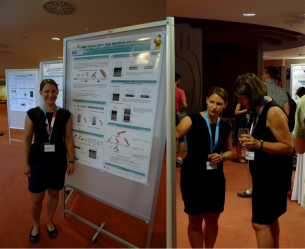
Anne Gärtner, PhD student in the group of Prof. Stefan Müller, was awarded with the Nature Reviews poster prize at the EMBO meeting “Ubiquitin and ubiquitin-like modifiers” (Cavtat, Croatia).
Anne’s work elucidates the modification of the small ubiquitin-related protein SU MO with an acetyl group and the impact of this post-translational modification on SUMO chain formation and downstream cellular effects.
... (read more)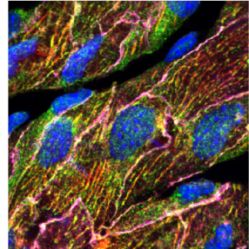
As reported in today’s online version of Circulation Research the group of Dr. Stefanie Oess has identified the F-BAR protein NOSTRIN as a crucial factor in the development of endothelial dysfunction, hypertension and diastolic heart failure.
In this study the authors show that NOSTRIN is necessary for the correct positioning of the muscarinic acetylcholine receptor M3R at the plasma membrane of endothelial cells.
In the absence of NOSTRIN the function of the M3R was markedly impaired, resulting in abolition of the calcium response to acetylcholine, an impaired activation of endothelial nitric oxide synthase and the inhibition of vascular relaxation, leading to hypertension and diastolic heart failure.
... (read more)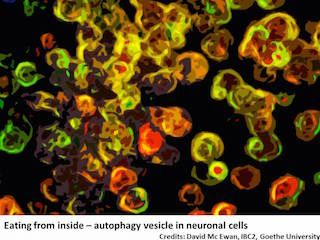
Defects in the quality control systems of cells are often fatal. This is seen in particular in neurodegenerative diseases such as Alzheimer's or Parkinson's.
As published in today’s online version of Nature, a research team led by Ivan Dikic discovered a new autophagy receptor which plays a central role in cellular quality control. Mutations in this receptor impair its function and cause a hereditary neuropathy named HSAN II. This milestone study not only gives insight into the pathophysiology of a disastrous disease, but also emphasizes the importance of the autophagy network for the wellbeing of cells.
... (read more)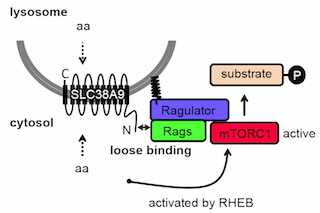
The serine/threonine kinase mTORC1 regulates cellular homeostasis in response to many cues such as nutrient status and energy level. Amino acids induce mTORC1 activation on lysosomes via the small Rag GTPases and the Ragulator complex, thereby controlling protein translation and cell growth.
As reported in Molecular and Cellular Biology the group of Dr. Christian Behrends identified the human 11-pass transmembrane protein SLC38A9 as a novel component of the Rag-Ragulator complex on lysosomes.
... (read more)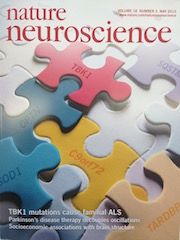
ALS (Amyotrophic lateral sclerosis ) is a devastating disease characterized by loss of motor neurons and neurodegeneration, usually leading to death within 3-4 years.
Despite being classified as rare disease, public awareness is very high, fueled by celebrity patients like Stephen Hawking and culminating in last years’ Ice Bucket Challenge, the first charity campaign with global impact. Still, there is no treatment for ALS, despite intensive research in the field.
Researchers from IBC2 and BMLS have now made a major step to a better understanding of the genes causing ALS.
... (read more)